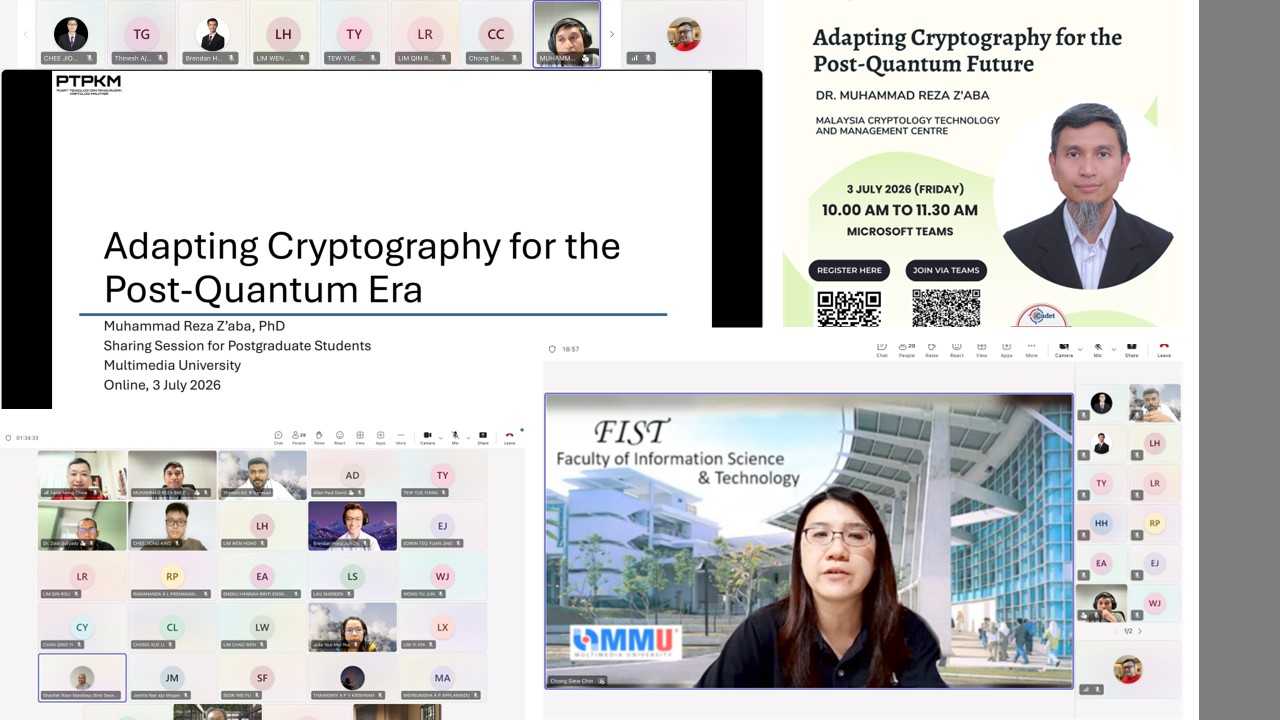
On 3 July 2026, the Faculty of Information Science and Technology (FIST), Melaka Campus, hosted an online Industry Knowledge Sharing session entitled “Adapting Cryptography for the Post-Quantum Future.” The session featured Dr. Muhammad Reza Z’Aba from the Malaysia Cryptology Technology and Management Centre (PTPKM), who shared his expertise on the growing impact of quantum computing on modern cryptography and cybersecurity.
The session brought together academics, researchers, and students to explore how advances in quantum computing are reshaping the cybersecurity landscape and the measures needed to safeguard digital systems in the years ahead. As quantum technologies continue to evolve, organisations are expected to face new security challenges that require stronger and more resilient cryptographic solutions.
Drawing on his research and industry experience, Dr. Reza explained how the increasing capabilities of quantum computing could eventually affect widely used public-key cryptographic algorithms. He also highlighted ongoing international efforts to develop and standardise post-quantum cryptography. In addition, participants gained insights into emerging research trends, cryptographic standards, and the importance of planning an early transition to post-quantum security.
Dr. Reza is a cryptographer at PTPKM and previously served as a Staff Researcher at MIMOS Berhad and a Senior Lecturer at the Faculty of Computer Science and Information Technology, University of Malaya (UM). He holds a Bachelor of Science (Computer) from Universiti Teknologi Malaysia and a PhD from Queensland University of Technology, Australia. His research interests include symmetric cryptography, authenticated encryption, block ciphers, cryptographic protocols, blockchain technologies, and information security.
The session also encouraged active discussions among participants on the future of cybersecurity in the quantum era, including the roles of researchers, industry, and policymakers in addressing emerging technological challenges. The interactive exchange of ideas provided participants with a broader perspective on the importance of cryptography in protecting digital infrastructure and ensuring long-term information security. Through the sharing session, participants gained a deeper appreciation of current developments in cryptographic research and the importance of developing secure digital systems for the future. Dr. Reza also provided some supportive resources for postgraduates whom may be interested in the field.