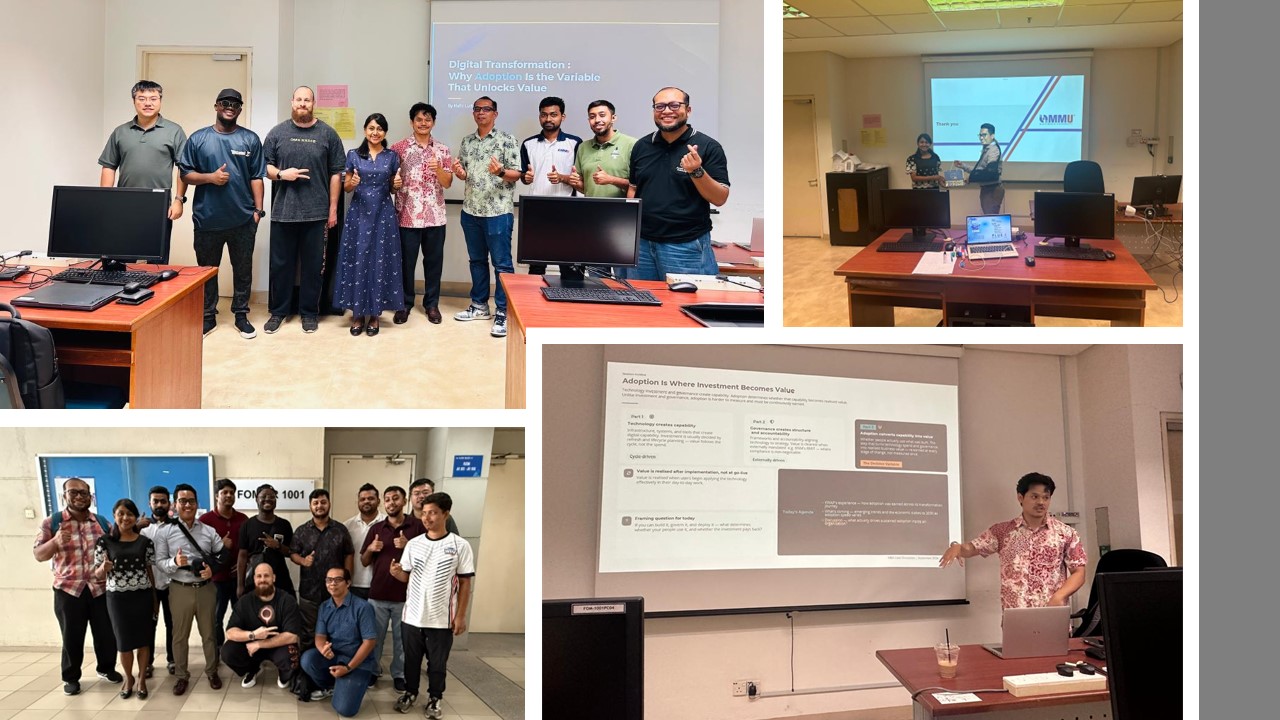
Digital transformation involves more than implementing new technology. It requires leadership, effective processes and people who are ready to adopt change. This was the key takeaway from two industry sharing sessions organised for MBA students at the Faculty of Management (FOM), recently.
The sessions were coordinated by Assoc. Prof. Ts. Dr. Lilian Anthonysamy. The course features industry practitioners as appointed Industry Learning Partners, bringing workplace experience into the classroom.
Ahmad Farouk Ahmad Fauzi, Executive (NZCE Delivery & Embedment) at the Corporate Sustainability Division, PETRONAS, and an MMU Bachelor of Finance alumnus, shared his career journey in a session titled My Journey in Digital Leadership. Drawing on his experience across several organisations, including Malaysia Airports (Niaga), Al Rajhi Bank, Agrobank and PETRONAS, he discussed how digital leadership involves aligning business strategy, processes, people and technology.
He also introduced practical approaches to problem-solving, stakeholder management and change management, supported by examples from his work at PETRONAS. Students then applied these approaches in a paired simulation based on real career or workplace challenges.
A complementary perspective came from Muhammad Hafiz Luthfi Bin Mohd Ariffin, Associate, Strategy and Planning at the Digital Strategy Department, Kumpulan Wang Persaraan (KWAP). In his case discussion, Digital Transformation: Why Adoption Is the Variable That Unlocks Value, he explained that the value of technology depends on whether people use it effectively after implementation.
Using KWAP’s publicly reported transformation journey from 2021 to 2026, he illustrated how technology initiatives must be supported by changes in processes and organisational practices. The discussion covered developments in automation, AI tools and data governance, highlighting the role of people and organisational readiness in achieving the intended outcomes of digital transformation.
Together, the sessions gave students the opportunity to examine digital transformation from two complementary perspectives: leading change and ensuring that technology delivers practical value. The industry contributions also connected the course concepts with the decisions and challenges faced by organisations in implementing digital initiatives.