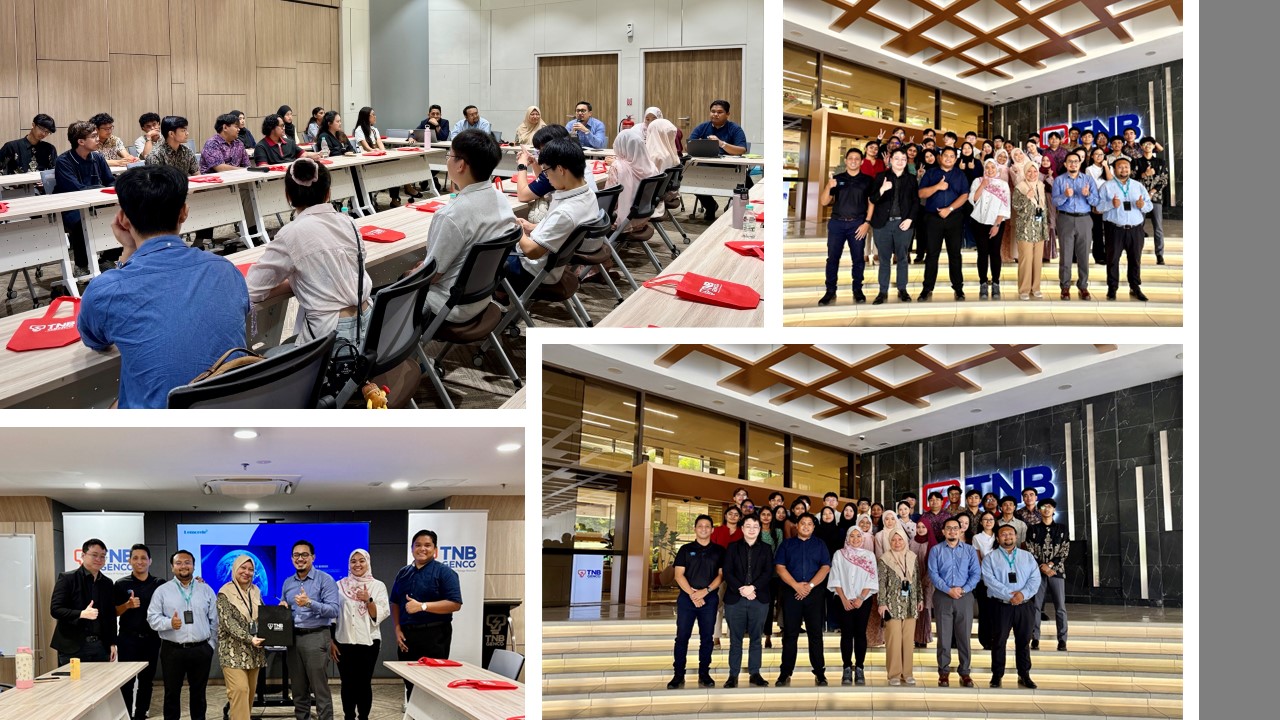
A visit to TNB GENCO, a subsidiary of Tenaga Nasional Berhad (TNB), was recently conducted for students from the Faculty of Management (FOM) in collaboration with the Chartered Institute of Management Accountants (CIMA). Accompanied by their lecturer, Dr. Mariati Norhashim, the visit served as an avenue for students to gain first-hand exposure to the application of Strategic Management Accounting in the energy industry.
The visit featured a knowledge-sharing session by Ir. Mohd Rafie bin Samsudin, Senior Manager (Strategic Planning and Advisory); Ms Nurul Hanani binti Abdullah, Manager (Strategic Planning); Muhammad Fakri bin Abdul Salam, Manager (Business Performance and Reporting); Mohd Ezarin bin Mazlan Acma, CGMA, CA(M), ACPA, Chief Financial Officer of Integrax Berhad; and Faiq Khalil bin Mohd Amin, Senior Manager (Business Performance and Delivery). The speakers shared their experiences and provided practical insights into strategic planning, business performance, financial management, and corporate decision-making within the organisation.
During the session, students were introduced to TNB GENCO’s role as a power generation company and learned about the functions of its related entities, including Integrax Berhad and TNB REMACO. They also gained a better understanding of how corporate strategies are developed and translated into performance management systems to support business objectives.
One of the key topics discussed was the Energy Trilemma, which focuses on balancing affordability, sustainability, and energy security. The speakers also shared TNB GENCO’s long-term aspiration to transition from “Brown to Green” by 2050 as part of its commitment to supporting a more sustainable energy future.
The session concluded with an interactive discussion, during which students engaged with the speakers on topics such as risk management, industry challenges, renewable energy, and Malaysia’s evolving energy landscape. The discussions also touched on emerging energy sources, including solar and nuclear power, as well as the country’s transition from coal to cleaner energy alternatives.
Overall, the visit enabled students to relate concepts learned in the classroom to current industry practices while gaining a better understanding of the strategic and sustainability challenges faced by organisations in the energy sector.