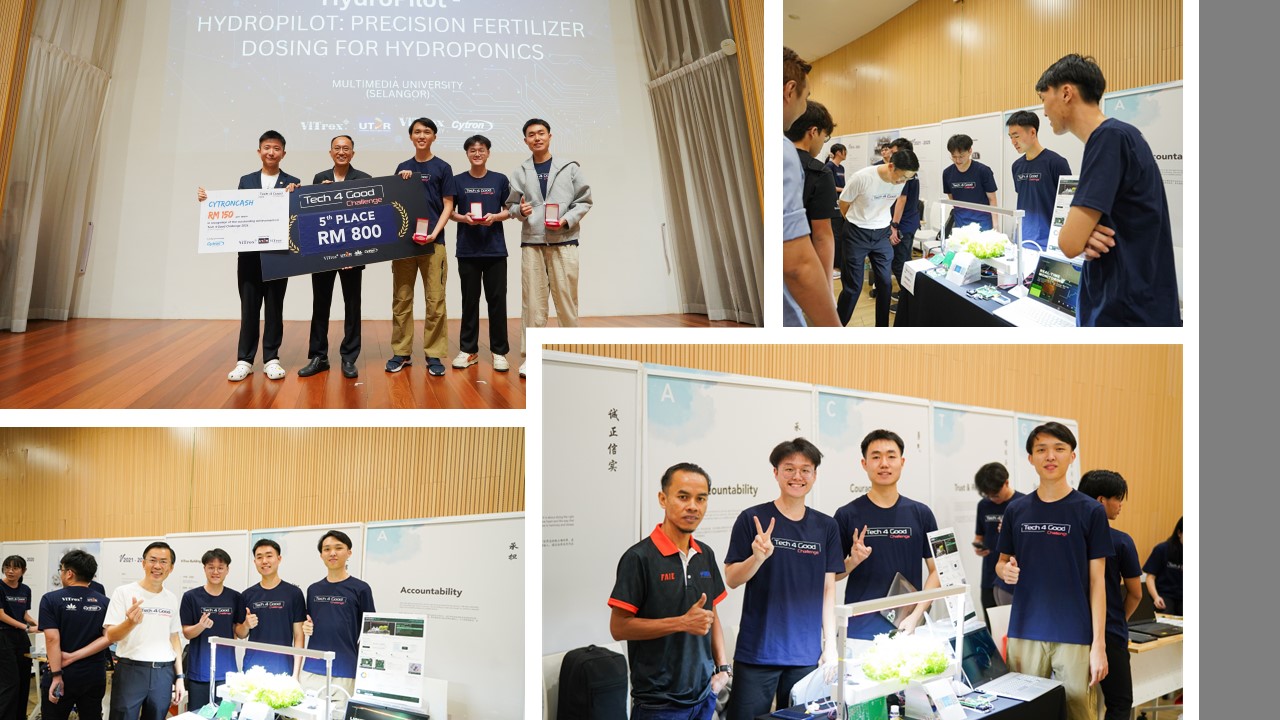
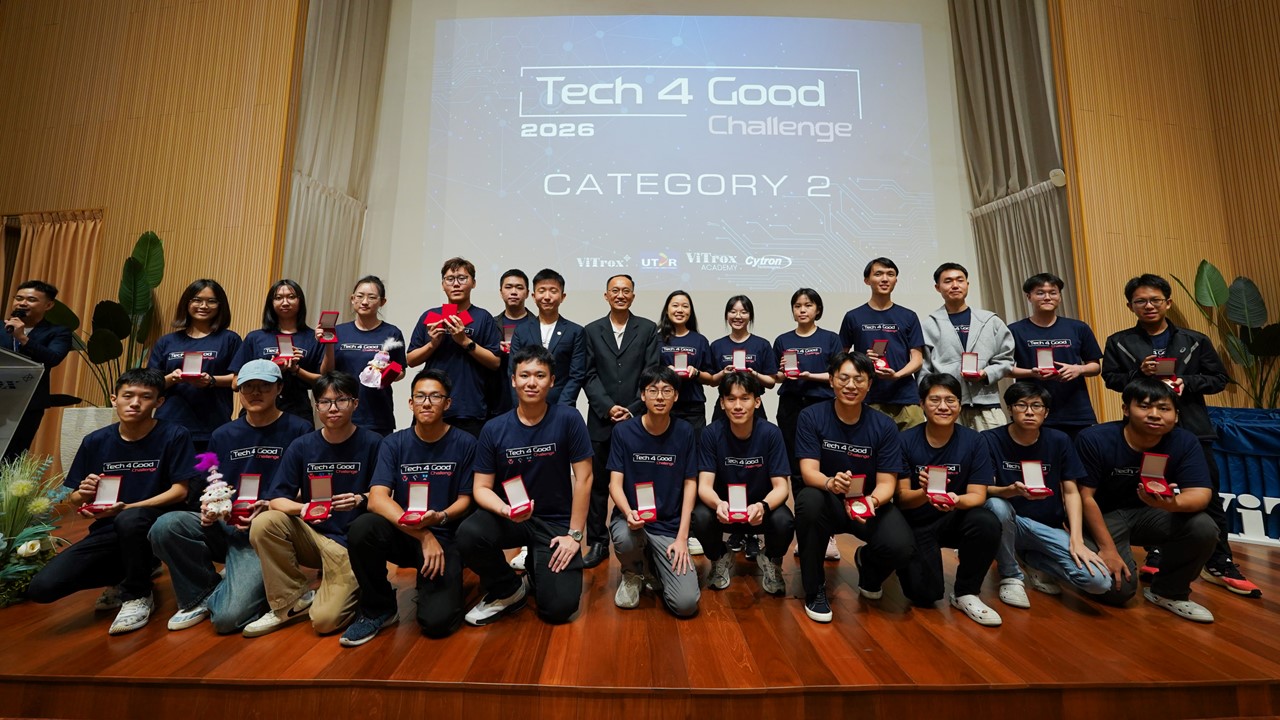
A team of engineering students from the Faculty of Artificial Intelligence and Engineering (FAIE) has been awarded fifth place in Category 2 of the Tech 4 Good Challenge 2026 for their innovative project, HydroPilot: Precision Fertilizer Dosing for Hydroponics.
The team, comprising Lim Zing, Yo Yong Jun and Christopher Seow Qi Feng, received RM800 in prize money and RM150 in CytronCash for their achievement, recognising their efforts in developing an affordable automated fertiliser dosing system for home and small-scale hydroponic farming.
HydroPilot was developed to address common challenges faced by hydroponic growers, particularly the manual measurement and mixing of Fertilizer A and Fertilizer B, which can be time-consuming and prone to inaccuracies. As different crops require varying nutrient concentrations throughout their growth cycles, precise nutrient management is essential to ensure optimal plant growth.
To overcome these challenges, HydroPilot uses an automated closed-loop control system that continuously monitors the electrical conductivity (EC) level of the nutrient solution and dispenses the required amount of fertiliser until the desired concentration is achieved. Users can monitor the system in real time and configure the target EC level through an embedded touchscreen or an Android mobile application.
Powered by a custom-designed PCB featuring an ESP32-S3 microcontroller, the system integrates nutrient sensing, dosing pumps, water circulation, grow-light control and real-time monitoring into a single platform. Its closed-loop approach helps maintain stable nutrient levels while reducing the risk of over-dosing.
Compared to commercial automated dosing systems that may cost several thousand Ringgit, the HydroPilot prototype was developed at an estimated cost of approximately RM310. This reflects the team’s aim of making precision hydroponic technology more accessible to Malaysian home growers and small-scale farmers.
Through this project, the students gained valuable hands-on experience in embedded systems, PCB design, mobile application development, sensor integration and sustainable agricultural technology, demonstrating the role of engineering innovation in addressing real-world challenges.
Well done!